Aghlabid Basins
This content and any associated links were generated with the assistance of artificial intelligence
and may still require editorial adjustments.
You are solely responsible for verifying the accuracy of the information,
reviewing external sources, and planning your visit accordingly.
Welcome to Aghlabid Basins, Kairouan
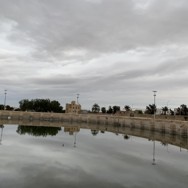
The Aghlabid Basins are a remarkable 9th‑century hydraulic system located just outside the medina of Kairouan in Tunisia. Constructed between 860 and 862 under the Aghlabid dynasty, these two polygonal cisterns served as a sophisticated water‑supply and sedimentation facility, showcasing medieval Islamic engineering at its finest.
Historical Context
Commissioned by Prince Abu Ibrahim Ahmad and supervised by Khalaf al‑Fata, the basins consist of a smaller 17‑sided settling tank (≈37 m diameter) and a larger 48‑ to 64‑sided storage basin (≈129 m diameter, ≈4.8 m deep), capable of holding over 57,000 m³ of water. Water was channeled from Oued Merguellil and 36 km away via aqueducts, with the system refined in the Fatimid era. This ensemble remains one of the most significant examples of medieval Islamic water engineering.
Landmarks
- Great Mosque of Kairouan: One of the earliest and most influential mosques in the Islamic West, established in the 9th century, featuring a hypostyle hall, marble columns, and a monumental minaret.
- Mosque of the Three Doors: Dating from 866 AD, notable for its sculpted façade, the oldest of its kind in Islamic art.
- Aghlabid Basins: The twin cisterns themselves, an extraordinary hydraulic monument of the Aghlabid period.
- Medina of Kairouan: A living urban fabric of winding streets, traditional houses, and city walls, illustrating medieval Islamic urbanism.
- Zaouia of Sidi Sahab: A richly tiled complex combining a mausoleum and madrassa, significant for spiritual and architectural heritage.
Museums
-
Dar Hassine Allani (House‑Museum)
A beautifully preserved 18th‑century traditional house offering insight into the lifestyle, architecture, and domestic culture of historic Kairouan.
Visit Website
Opening Hours: Not officially listed; open irregularly, reportedly within the medina—confirmation locally advised.
Ticket Price: Approximately 10 TND (~$3 USD) as per visitor reports.
-
National Museum of Islamic Art, Raqqada
Located a few kilometers south of Kairouan at the ancient Aghlabid capital Raqqada, this museum houses a collection of Islamic art and artifacts from the Aghlabid era and beyond.
Visit Website
Opening Hours: Not available online—please verify on‑site or via local sources.
Ticket Price: Not listed—typical Tunisian museum fees range between 5–8 TND for foreigners.
Tips for Visitors
- Visit the Aghlabid Basins early morning or late afternoon to enjoy cooler temperatures and softer light; entry is free and open daily from about 08:00 to 18:00.
- The multi‑site day ticket for Kairouan, priced around 12 TND (~$4 USD), often includes access to most major landmarks including the basins and Islamic arts museum.
- Wear comfortable walking shoes and bring water—many sites have uneven surfaces.
Sources
- Detailed description of the basins' construction and function: Jamila Binous et al., Ifriqiya: Thirteen Centuries of Art and Architecture in Tunisia (Museum With No Frontiers); guide‑voyage‑tunisie.com description (guide-voyage-tunisie.com/en/the-aghlabid-basins/))
- Engineering specifics and UNESCO listing: UNESCO World Heritage description; ArchNet/Encyclopedia sources ([whc.unesco.org)
- Restoration project and current status: webdo.tn and news‑tunisia sources (webdo.tn)
- Opening hours and free entry info: Lonely Planet and rehlat.com (lonelyplanet.com)
- Visitor price for Dar Hassine Allani: TripAdvisor reports (tripadvisor.es)
- City pass pricing: globetravelbudget.com (globetravelbudget.com)